June 3, 2026
What Is Ad Arbitrage? A 2026 Guide for Media Buyers and Affiliates
Learn what advertising arbitrage is, how advertisers profit from traffic arbitrage, and how to scale campaigns without account bans.


Most performance marketers run into ad arbitrage long before they have a name for it. You see a competitor running TikTok creatives for a quiz funnel, follow the redirect chain, and end up on a programmatic content page stacked with display units. The spread between what they paid for the click and what the page earns from the session is the whole business.
Ad arbitrage can still work in 2026, but the easy version of the business is mostly gone. Margins are thinner, enforcement is stricter, and operational requirements have climbed since iOS 14.5 and App Tracking Transparency weakened deterministic attribution across major paid-social channels.
Here’s how ad arbitrage actually functions, where the money still sits, and where Facebook agency ad accounts can fit when Meta operators need more stable paid-social infrastructure for real spend.
Ad Arbitrage Explained
Ad arbitrage is the practice of buying traffic for less than you can monetize it. The difference between traffic cost and revenue per visitor is your gross spread. Your actual margin is what remains after fees, tracking loss, payout adjustments, compliance costs, and operational overhead.
For example, if a media buyer pays $0.30 for a click and the resulting session earns $0.55, the campaign has a $0.25 gross spread before tools, platform fees, payment delays, clawbacks where applicable, and other operating costs.
That simple spread is what attracts operators to the model. The hard part is keeping it alive at scale.
Many paid-media models involve a gap between traffic cost and downstream revenue. But ad arbitrage usually refers to operators whose main business is buying traffic and monetizing that traffic directly through ads, offers, leads, subscriptions, or revenue-share payouts.
The real question is not whether arbitrage exists. It is whether the math works after traffic quality, platform rules, payout terms, account stability, and tracking gaps are priced in.
A Simple Ad Arbitrage Example
Here is a simplified version of the math.
A media buyer sends paid traffic to a slideshow site. Each visitor lands on a multi-page article with display ads placed throughout the experience. If the average session earns less in display revenue than the click cost, the campaign loses money. If the session earns more than the click cost after fees and traffic loss, the campaign has room to scale.
The operator has a few levers:
- Lower the CPC without destroying traffic quality
- Improve page speed so fewer users bounce before ads load
- Increase session depth without creating a frustrating experience
- Improve ad viewability and layout
- Raise monetization through a stronger ad stack
- Cut traffic sources, creatives, or geos that do not clear the revenue threshold
Every arbitrage campaign reduces to that same loop. Traffic cost on one side, monetization on the other, and a small set of levers between them.
Who Uses Ad Arbitrage?
The model attracts a specific kind of operator.
Content site owners run display arbitrage at volume. Affiliate marketers buy traffic to push offers from networks like MaxBounty, ClickBank, or private CPA networks. Lead gen operators work in verticals like insurance, solar, home services, personal injury, debt relief, or Medicare, where lead value depends on quality, exclusivity, geography, buyer demand, and compliance requirements. Sweepstakes operators run CPL funnels. Ecommerce operators buy traffic to product pages where AOV and repeat purchase value can cover blended CAC.
Many of these operators are running a math problem with a media budget attached. The more durable ones still have to treat content quality, compliance, tracking, payment terms, and account infrastructure like real business assets.
How Advertising Arbitrage Works
Every advertising arbitrage campaign reduces to three moves: buy traffic below its monetized value, send that traffic to a page or offer that earns more than it costs, and read the numbers fast enough to cut what loses money.
Step 1: Buy Traffic Below Its Monetized Value
The traffic-cost side of the equation depends on platform, audience, creative, geo, placement, account quality, and competition inside the auction.
A buyer pushing celebrity gossip to broad US audiences on Facebook competes against DTC brands, app advertisers, lead-gen buyers, and other performance marketers. The same angle pointed at lower-cost geos may reduce CPMs, but session monetization usually changes too. The opportunity exists only where the traffic discount is larger than the revenue drop.
Creative does the heavy lifting. Operators running arbitrage at scale usually need a steady pipeline of new creative variants to keep blended CPCs from drifting upward as audiences fatigue.
The traffic has to be cheap enough to work, but not so low-quality that the page cannot monetize it.
Step 2: Send Users to a Monetized Page or Offer
The landing experience decides what the click is worth. In most ad arbitrage campaigns, paid traffic goes to one of three monetized destinations:
- Programmatic content pages: articles, slideshows, quizzes, or content hubs monetized through display units from Google AdSense, Mediavine, Raptive, or programmatic stacks using Prebid and other demand sources.
- Affiliate landers: pre-sell pages that warm the user before handing them off to a network or merchant offer, where the operator earns CPA, CPL, or revenue share.
- Direct-response funnels: lead forms, quiz funnels, or ecommerce product pages where conversion happens on the operator’s own infrastructure.
Each format has the same business job: generate more compliant revenue from the session than the click cost to acquire it.
That does not mean stuffing a page with ads until users leave. The more aggressive the layout, redirect chain, or claim structure becomes, the more platform, partner, and user-experience risk the operator takes on.
Step 3: Track Revenue, Costs, and Profit Margin
Tracking gets harder every year.
iOS 14.5 and App Tracking Transparency weakened deterministic attribution across paid social. Browser privacy changes, third-party cookie uncertainty, consent requirements, and weaker cross-site identity have made it harder to reconcile display revenue and conversion signals back to traffic sources.
Many serious arbitrage operators use server-side tracking, affiliate trackers, ad-server logs, CAPI, postback flows, or in-house reporting to reconcile platform numbers against their own revenue data.
The campaign-level math is simple:
Revenue per visitor minus cost per visitor, multiplied by volume.
The operating reality is not simple. A modest CPC increase, RPM drop, payout adjustment, platform fee, tracking error, clawback, or account pause can turn a profitable campaign unprofitable quickly, which is why operators need clean cost-per-result analysis before scaling.
Common Monetization Models
Operators monetize arbitrage traffic through a few recurring structures. The model you choose determines payout timing, compliance load, tracking complexity, and how fast you can tell whether the campaign works.
The most common ad arbitrage monetization models are:
- Display advertising: the classic content-arbitrage play, where the operator earns through CPM, viewable CPM, or session-value monetization from programmatic exchanges and publisher ad stacks.
- CPA and CPL offers: performance offers where the user takes a defined action, such as a form fill, signup, quote request, trial, or purchase, and the operator earns a flat payout per qualified conversion.
- Revenue share: a model where the operator earns a percentage of downstream user activity. This is common in subscription, finance, and other regulated verticals where the advertiser has the required approvals and compliance controls.
- Hybrid deals: a structure that combines a CPA or CPL payout with a smaller revenue-share tail, often used when networks want operators to share both upside and traffic-quality risk.
The monetization model decides almost everything downstream: how long it takes to know a campaign works, how much creative variance the funnel can tolerate, how much compliance review is needed, and how much working capital sits between spend and payout.
Is Ad Arbitrage Illegal?
Ad arbitrage is not inherently illegal. Buying traffic and monetizing it elsewhere is common across publishing, affiliate marketing, lead generation, ecommerce, and direct response.
The legal risk depends on what the operator does inside the model: claims, disclosures, data handling, consent, traffic quality, monetization method, vertical licensing, and downstream buyer practices.
Legal vs Fraudulent Arbitrage Practices
A legitimate arbitrage operator runs compliant creative, sends users to the page or offer the ad promised, monetizes through legal channels, respects data and disclosure requirements, and keeps traffic quality aligned with partner terms.
Operators can run display arbitrage, affiliate funnels, and lead gen legally. But legal operation requires more than avoiding obvious fraud. Creative claims, landing-page disclosures, privacy practices, TCPA or telemarketing issues, vertical licensing, lead resale terms, and partner compliance all matter.
Fraudulent arbitrage usually involves one of a few patterns.
Cloaking, where the ad reviewer sees a different page than the user, sits near the top of the list. Forged landers built around government or business impersonation can cross into criminal fraud, especially when they mimic banks, agencies, publishers, celebrities, or platform login screens. Bot-driven click inflation, fake lead generation, incentivized traffic sold as organic, and fabricated conversions all carry serious legal and commercial exposure.
Regulators have pursued deceptive lead-generation operators, especially where users were misled about what they were signing up for, how their data would be used, or who would contact them.
The line is not subtle. Operators who stay close to it usually know they are close to it.
Platform Rules and Advertising Policies
Meta, TikTok, and Google have written policies that often bite harder than the law.
Meta’s ad rules restrict deceptive or misleading practices, scam-like offers, suspicious advertiser behavior, and tactics that misrepresent what users or reviewers will see after clicking.
TikTok’s ad policies heavily affect many verticals arbitrage operators often test, including weight management, financial services, healthcare, gambling, deceptive claims, and other regulated or restricted categories.
Google Ads destination requirements put ad-heavy, thin, misleading, or hard-to-navigate arbitrage pages at risk, even when the underlying business model is legal.
That distinction matters. A campaign can be legal and still get rejected, restricted, or disabled if it violates platform policy or triggers account-risk systems.
Most arbitrage operators learn that lesson the expensive way. That is one reason account infrastructure starts to matter once spend gets serious.
Is Ad Arbitrage Still Profitable in 2026?
Yes, but the easy version of the business is much harder to find.
Margins are thinner. Enforcement is stricter. Tracking is weaker. Weak accounts break faster. Thin content gets less tolerance. Networks are more aggressive about clawbacks and lead quality. Platforms are better at identifying recycled creatives, misleading landers, and suspicious account behavior.
The operators still winning in 2026 are running tighter funnels, cleaner data, stronger creative operations, and better account infrastructure than the operators who left.
What Affects Profit Margins Today
Several forces have compressed ad arbitrage margins. None of them kills the model on its own, but together they make the break-even point harder to reach.
The biggest margin pressures today are:
- Higher traffic costs in competitive auctions: in many Tier 1 geos and high-value verticals, traffic costs have risen enough to pressure arbitrage spreads.
- Attribution loss: post-ATT tracking gaps, consent limits, browser privacy changes, and third-party cookie uncertainty mean operators send weaker signals back into buying platforms.
- Automated campaign systems: Meta Advantage+ and TikTok Smart+ can make cheap, underpriced pockets harder to isolate because platforms increasingly optimize delivery across broader signals.
- Display monetization volatility: display revenue can move with seasonality, ad demand, viewability, consent rates, traffic quality, supply-path changes, and advertiser budgets.
- Platform enforcement: campaigns that used to run for weeks can now hit review, rejection, or account restriction before the operator gets enough data to stabilize the funnel.
Each force is survivable on its own. Stacked together, they push break-even points up to where weaker operators give up.
Where Margins Still Exist
Margin has not disappeared. It has migrated.
The strongest opportunities usually sit in a few places:
- Geo arbitrage in lower-cost markets: traffic may be cheaper, but the economics only work when the drop in monetization is smaller than the drop in media cost.
- Vertical-specific lead gen: fragmented buyer demand and strong commercial intent can create margin in verticals such as solar, Medicare, debt relief, home services, legal intake, and insurance.
- Subscription and revenue-share verticals: lifetime value can justify more aggressive front-end CAC when compliance, payout terms, and retention quality are clean.
- TikTok content arbitrage: native-feeling creative can still produce traffic costs low enough to beat the monetization rate, provided the operator has enough creative volume, policy fit, and account stability.
The pattern is consistent. Margin lives wherever creative, geo, monetization, or vertical insight gives one operator an edge the auction has not fully priced in yet.
Why Ad Arbitrage Campaigns Fail
Most arbitrage campaigns fail for one of a small set of reasons. The math may look simple, but the operating layer is where campaigns usually break.
The most common failure points are:
- Account instability: the campaign is working, then the business manager or ad account gets restricted, and the operator cannot relaunch fast enough to hold creative momentum.
- Weak tracking: revenue numbers and ad-spend numbers do not match, so the operator scales losing campaigns before noticing.
- Creative fatigue: the same angles run too long, CPC creeps up, and the spread closes.
- Funnel leakage: landing-page load times, redirect chains, mobile rendering issues, or broken tracking bleed traffic before it reaches the monetized event.
- Misread payout terms: networks shave on lead quality, claw back conversions, delay payment, or pay on terms that break the operator’s working-capital cycle.
Account instability is one of the hardest failures to recover from because it can stop a working campaign before the operator has time to diagnose anything else.
A disabled business manager carrying meaningful daily spend can stop the business, not just the campaign.
Ad Arbitrage vs Affiliate Marketing
Ad arbitrage and affiliate marketing overlap heavily, which is why operators argue about the definitions.
The cleanest separation is structural rather than tactical.
Key Differences in Traffic Flow
In a pure affiliate model, the operator drives traffic to someone else’s offer and earns a commission on conversions the network or merchant tracks. The traffic source might be paid, organic, email, search, or social, but the operator does not fully own the monetization layer.
In ad arbitrage, the operator owns or controls more of the monetization layer. Traffic gets routed through the operator’s own page, funnel, ad stack, lead form, or offer path before revenue is collected.
Many paid affiliate campaigns are arbitrage-like because the operator is buying traffic and trying to earn more from the conversion than the click cost. Many arbitrage campaigns also use affiliate or CPA offers inside the monetization stack.
The labels matter less than the answer to one question: who controls the page or funnel where the money gets made?
When Each Model Makes More Sense
Some campaigns fit one model cleanly.
Lead gen for solar in California can fit inside an affiliate or lead-gen model when the network handles buyer relationships, consumer matching, compliance requirements, and payout terms. A celebrity gossip site monetized through display sits more clearly inside ad arbitrage because the operator owns the content environment and monetization policy.
The table below shows the practical difference. The categories overlap, but the operating burden changes depending on who owns the monetization layer.
The better model usually comes down to working capital, compliance appetite, payout terms, and how much infrastructure the operator wants to own versus rent.
Common Traffic Sources for Ad Arbitrage
Most paid traffic for arbitrage comes from a few major sources. Each has a different cost structure, audience profile, approval pattern, and account-risk profile.
Facebook and Instagram Ads
Meta remains one of the largest paid traffic sources for arbitrage because it combines scale, broad audience access, mature optimization, and fast creative testing.
A profitable creative on Facebook can scale aggressively before audience saturation hits, but the ceiling depends on geo, vertical, account quality, creative fatigue, landing-page compliance, and whether performance signals stay strong as spend increases.
The tradeoffs are sharp. CPMs in Tier 1 geos can be high, especially in competitive verticals where DTC, app, ecommerce, and lead-gen advertisers overlap. Meta’s enforcement on policy-sensitive verticals can also make cold or lightly used business managers fragile.
Many high-volume or policy-sensitive arbitrage operators consider agency ad accounts or partner-supported setups for stability, spend-cap management, support access, and continuity planning.
TikTok Advertising
TikTok became attractive to many arbitrage operators because native-feeling creative can sometimes produce lower traffic costs than more mature social auctions.
The platform rewards content that feels native to the feed, which favors operators willing to produce rough, fast, high-volume creative instead of polished brand ads.
The friction points look different from Meta. Account approvals, review consistency, creative policy, landing-page claims, and affiliate-style funnels can all create risk. For high-volume operators, TikTok agency ad accounts may become part of the infrastructure conversation once review delays, spend caps, or account instability start constraining scale.
Google Ads and Search Traffic
Google Ads serves arbitrage differently.
Search traffic carries intent, which usually means higher CPCs, lower volume, and tighter funnel expectations. Lead gen operators in solar, legal, Medicare, insurance, and home services use search because a high-CPC click can still work when the downstream lead value is strong enough.
Google Display Network and YouTube can also serve arbitrage spend, but destination quality, misrepresentation, bridge-page issues, and thin-content concerns need tighter control.
Google Ads suspensions can be difficult to recover from, especially when the issue involves destination quality, misrepresentation, circumventing systems, or repeated policy violations.
Native Ad Networks
Taboola, Outbrain, Revcontent, MGID, and similar native networks have long served content arbitrage, especially slideshow, advertorial, quiz, and article-based monetization.
Native traffic often has a different reader profile than social traffic. It may skew older, more desktop-weighted, more content-driven, and more responsive to editorial-style hooks.
The upside is lower-friction content consumption. The downside is that conversion quality, compliance review, and ad-to-lander continuity still matter. A cheap native click is not useful if the session does not monetize or the network rejects the funnel.
Traffic Sources Compared
This table is not a universal benchmark. CPCs and account risk change by vertical, geo, creative, landing page, account history, and compliance setup. Use it as a planning map, not a fixed rate card.
How to Scale Ad Arbitrage While Reducing Account Risk
Account stability is the variable most operators underprice when they start scaling arbitrage. For Meta and TikTok operators, that risk becomes especially visible when creative is working, spend is climbing, and the campaign depends on one fragile account.
A creative angle that works at low daily spend can look stable right up until the operator pushes harder, the account hits review, and the funnel suddenly depends on one fragile account.
The campaign did not stop because the math was wrong. It stopped because the account structure could not carry the spend.
Stable Paid-Social Ad Accounts for High-Volume Arbitrage
For high-volume Meta and TikTok arbitrage, the infrastructure usually involves three things: mature paid-social accounts, compliant redundancy, and a support path that can respond while campaigns are live.
Agency ad accounts can reduce some of that pressure when they come with stronger support, clearer escalation paths, and better continuity planning.
Depending on the provider and platform relationship, agency-supported accounts may offer more mature account infrastructure, higher initial spend flexibility, better operational support, or clearer escalation paths than a new self-serve setup.
None of that removes policy risk. Arbitrage operators still need compliant creative, honest landing pages, stable payment flows, clean business entities, and a campaign structure that does not rely on evading platform enforcement.
Agency Ad Accounts vs Self-Serve for Arbitrage
The right setup depends on spend volume, vertical risk, policy sensitivity, and how expensive downtime has become. A small ecommerce test and a high-volume content-arbitrage operation do not need the same infrastructure.
The important word is “may.” Paid-social agency infrastructure can improve the operating environment on Meta and TikTok, but it cannot make weak claims, bad landers, fake engagement, or policy-edge funnels safe.
Reducing Account-Ban Risk When Scaling Spend
A few practices reduce account-risk exposure at scale.
- Scale spend gradually and consistently
Sudden spend jumps can increase review risk, especially on new or lightly used accounts. Give the account enough history for billing, creative review, and delivery patterns to look normal.
- Match the ad to the landing page
Cloaking, bait-and-switch landers, misleading redirect chains, and aggressive claim mismatches are some of the fastest paths to rejection, restriction, or disablement.
- Use compliant account architecture and redundancy
Do not create or rotate accounts to evade active restrictions. Any backup account structure should follow platform rules, business verification requirements, advertiser-entity consistency, and policy expectations.
- Keep creative compliance inside the workflow
Platform rules change, and media buyers often operate on stale assumptions. Someone should review claims, landing pages, vertical restrictions, and approval patterns before spend gets pushed.
- Monitor account-quality and policy surfaces
Watch available account-quality, policy, ad-review, billing, and notification surfaces. They can surface issues early, but not every restriction comes with a warning.
None of that eliminates risk. Platforms can restrict accounts even when the advertiser believes the campaign is compliant, and the first notice does not always explain the issue clearly.
Risk reduction is the goal. Risk elimination is not on the table.
When Meta and TikTok Arbitrage Operators Need Agency Ad Accounts
The threshold is usually some combination of spend, vertical, and pain.
An operator may have reached that point when:
- Daily spend is large enough that one restriction costs more than the infrastructure meant to prevent downtime
- The vertical is policy-sensitive and standard self-serve accounts face repeated reviews, restrictions, or support bottlenecks
- Meta or TikTok support response times have become a bottleneck on live campaigns
- The operator has already lost revenue from an account restriction and knows the real cost of downtime
- Meta or TikTok spend caps, billing limits, or payment constraints are limiting how fast a winning campaign can scale
- The team needs a more reliable escalation path when paid-social campaigns hit review
Operators who hit several of those signals at once often start evaluating agency-supported infrastructure because the cost of downtime becomes easier to quantify.
The math gets obvious once one serious account interruption costs more than building a better setup.
When Ad Arbitrage Makes Sense and When It Does Not
Ad arbitrage suits operators who are comfortable running tight-margin math at volume, who have working capital to absorb a bad week, and who want to own infrastructure rather than build brand equity.
The model rewards people who read data fast, ship creative faster, and walk away from losing campaigns without sentimentality.
It does not suit everyone.
Operators looking for more stable income and lower operational load may be better served by owned-audience affiliate models, but those still carry offer, compliance, and payout risk.
Founders building toward a defensible brand may find arbitrage corrosive to the patient creative work that compounds. Anyone who needs predictable monthly revenue should price in that arbitrage cash flow is lumpy, often correlated with platform behavior, and occasionally goes to zero for reasons outside the operator’s control.
Ad arbitrage is a real business in 2026. It is also harder than it used to be, with thinner margins, more infrastructure overhead, and less tolerance for sloppy execution.
Operators who treat it as a serious operation have a better chance of building meaningful revenue. Operators who treat it as a shortcut usually discover the shortcut is closed.
Advertising Arbitrage FAQs
How Much Money Can Ad Arbitrage Make?
Revenue varies sharply. Some operators never get past testing budgets. Disciplined teams with strong tracking, creative volume, monetization, compliance, and account infrastructure can build meaningful revenue across multiple campaigns or verticals.
What Are the Biggest Risks of Ad Arbitrage?
Account restrictions are one of the biggest risks because they can stop a working campaign instantly. Other risks include CPC increases, RPM drops, attribution gaps, policy changes, payout delays, clawbacks, and poor traffic quality.
Is Ad Arbitrage the Same as Ad Fraud?
No. Ad arbitrage is not inherently fraud. Ad fraud involves deceptive or invalid activity, such as cloaking, fake conversions, bot traffic, forged landers, or misleading users about what they are clicking.
Can Beginners Start With Advertising Arbitrage?
Yes, but with realistic expectations. Beginners should treat early spend as testing capital at risk, not predictable income. The first lessons usually come from tracking gaps, creative fatigue, compliance mistakes, and weak monetization.
How Long Does It Take to Know if an Ad Arbitrage Campaign Is Profitable?
Display arbitrage can show directional signal faster because revenue appears closer to the session. CPA and lead-gen campaigns often need more conversion volume, payout validation, and clawback visibility before the signal is reliable.
Explore more blog posts



Join the AdRevival family.
Conquer with us
Joining AdRevival will get you exclusive access to a community that collectively spends $20m/month on ads.
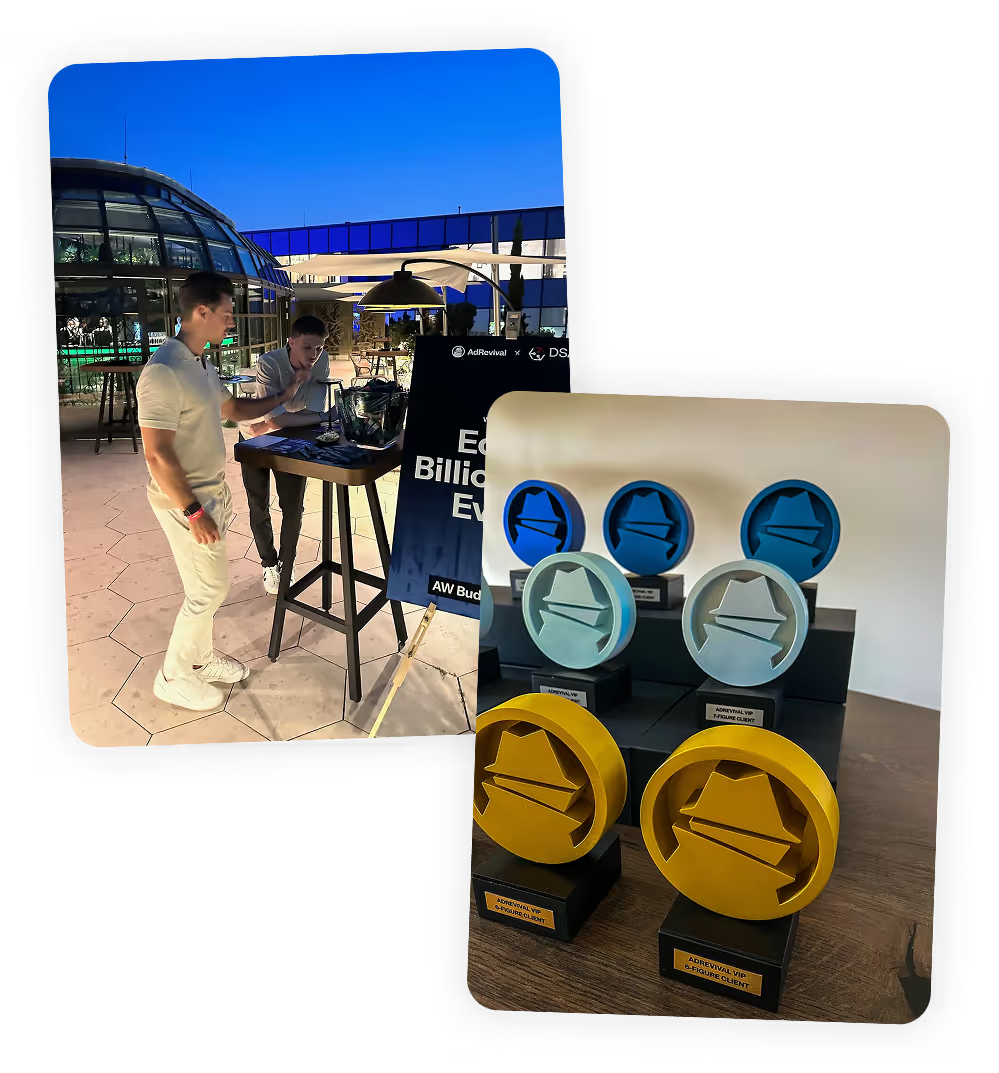
Get access to exclusive meetup events around the world. from Vegas to Bangkok.